
India’s real estate sector is expected to touch a market size of over $1 trillion by 2030, contributing nearly 13% to the country’s GDP. But while the industry continues to expand physically, its biggest transformation is happening elsewhere – in the way projects are marketed, perceived, and trusted.
The era of traditional real estate advertising is fading.
For years, developers relied on a predictable formula – glossy brochures, celebrity endorsements, newspaper jackets, and repetitive phrases like “luxury redefined” or “world-class living.” But today’s buyer is far more informed, digitally aware, and harder to influence.
In 2026, real estate marketing is no longer about selling apartments.
It is about selling conviction.
One of the biggest shifts driving this transformation is infrastructure-led aspiration. Across India, micro-markets like Dwarka Expressway, Noida Extension, Yamuna Expressway, and regions surrounding Noida International Airport have become investment magnets long before full development is complete.
Why?
Because buyers today are investing in future geography as much as physical property.
A recent industry trend shows that areas witnessing major infrastructure upgrades – expressways, metro connectivity, airports, and commercial corridors – are seeing significantly faster appreciation and buyer interest compared to traditional city centres. Infrastructure has become the new luxury.
Developers are no longer saying:
- “Look at this apartment.”
They are saying:
- “Look at where this city is heading.”
This shift has fundamentally changed marketing communication. The narrative is no longer limited to amenities or interiors. It now revolves around urban growth, connectivity, investment potential, and long-term lifestyle value.
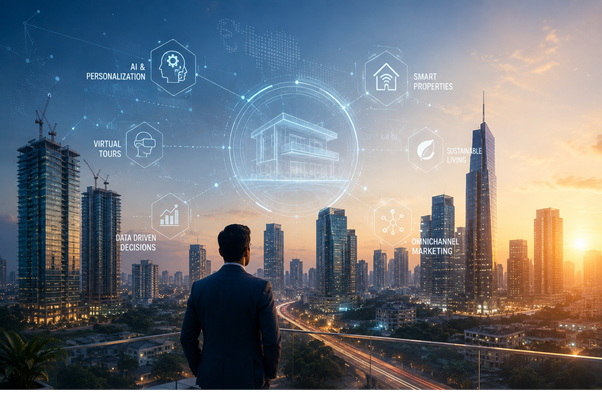
At the same time, Artificial Intelligence is rapidly reshaping the creative ecosystem. AI-generated architectural renders, automated ad targeting, experiential zones, predictive lead scoring, multilingual campaign adaptation, and real-time content generation are becoming standard marketing tools across the industry.
What previously required weeks of production timelines can now be executed within hours. According to multiple digital marketing reports, AI-driven personalisation can improve campaign engagement rates by over 40%, while automated lead analysis significantly reduces acquisition costs. For real estate brands competing in a crowded digital landscape, speed and precision are becoming critical advantages.
But beyond visibility and lead generation, another major shift redefining the industry is end-to-end value chain integration. Modern real estate marketing is no longer limited to awareness campaigns alone – developers today are focusing on complete customer journeys, from digital discovery and lead nurturing to site visits, sales experiences, relationship management, and final closures. A buyer discovering a project through an Instagram reel now expects the same premium experience across every touchpoint – whether it is the website, CRM communication, sales presentation, or post-sales engagement. This is why integrated marketing, experiential branding, CRM systems, and sales enablement are becoming critical parts of the modern real estate value chain. Because in today’s market, campaigns generate attention – but systems generate closures.
But there’s also an interesting contradiction emerging.
As AI-generated content becomes more common, human storytelling becomes more valuable. Because while AI can create visuals, it cannot replicate emotional intelligence, cultural instinct, or authentic strategic thinking. Technology can improve efficiency – but trust still depends on human understanding.
And trust is becoming the single most important currency in modern real estate marketing.
This is where influencer-led communication is changing the game.
Today’s buyers often discover projects through YouTube walkthroughs, Instagram reels, finance creators, or lifestyle influencers long before they interact with a sales team. In fact, consumer behaviour studies consistently show that audiences trust creator recommendations far more than traditional advertising.
But the future isn’t about celebrity influence. It is about credible influence.
A finance creator explaining investment potential can drive stronger conversion than a generic promotional ad. A hyperlocal content creator showcasing neighbourhood growth can create more relatability than a billboard campaign.
Modern buyers want information before persuasion. This is also why real estate advertising is slowly becoming more editorial.
Instead of aggressively pushing inventory, brands are increasingly building narratives around infrastructure growth, architecture, urban transformation, investment insights, and lifestyle evolution. The most effective campaigns today often resemble magazine features, documentaries, podcasts, or city reports rather than direct advertisements.
Because information builds authority.
Authority builds trust.
And trust drives decisions.
The buyer of 2026 is radically different from the buyer of a decade ago. They compare projects online within minutes, analyse developer credibility, study infrastructure pipelines, check reviews, and consume hours of digital content before making inquiries.
In such an environment, visibility alone is no longer enough. Brands need distinctiveness. And distinctiveness today comes from perception, storytelling, and cultural relevance – not just advertising budgets.
The future of real estate marketing in India will belong to brands that understand this shift early. Brands that can combine technology with human insight, infrastructure with aspiration, and content with credibility.
Because over the next decade, projects will not compete only through architecture. They will compete through narrative.